Preparing sensitive data for analytics, AI development, or testing should not require rebuilding a privacy-engineering process for every new dataset. Yet many organizations still rely on fragmented tools and custom scripts. One component profiles the data. Another masks identifiers. A third measures information loss. Engineering teams must then connect the results, manage exceptions, and establish what the processing actually achieved.
A successfully executed transformation does not necessarily mean that privacy risks have been adequately addressed or that the resulting data remains useful. PAMOLA.CORE brings these foundational operations into a common Python engineering framework.
A consistent foundation for privacy engineering
PAMOLA.CORE combines essential capabilities for working with sensitive tabular data:
- Data profiling to examine dataset characteristics, identify sensitive fields, and detect combinations of attributes relevant to privacy risk.
- Data protection through masking, suppression, generalization, pseudonymization, and other supported transformation methods.
- Privacy measurement to evaluate selected disclosure-risk indicators and the effects of applied protection methods.
- Fidelity and utility assessment to examine how transformations affect statistical properties and analytical usefulness.
- Reproducible processing through consistent operation interfaces, structured results, configuration records, metrics, and technical artifacts.
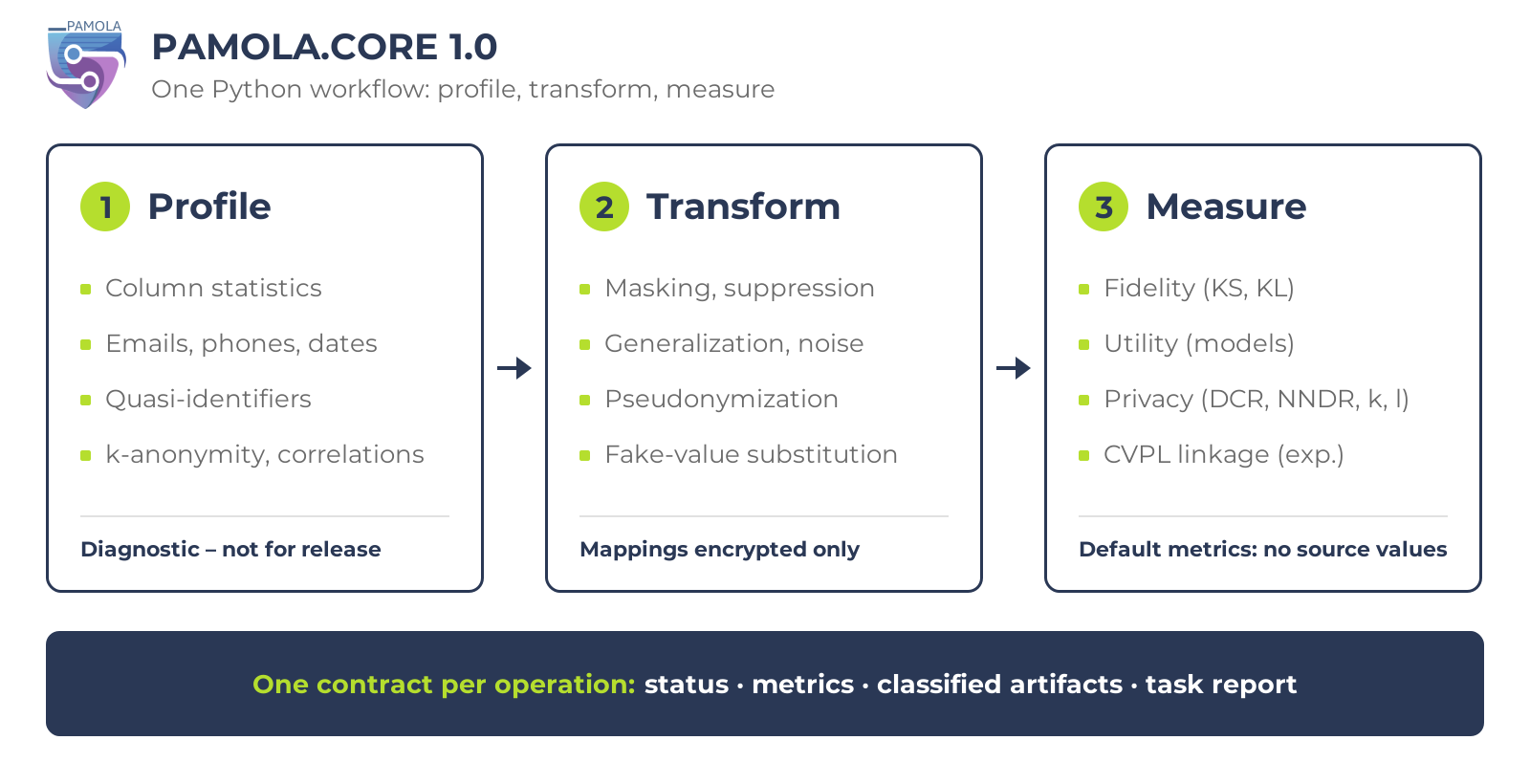
The objective is not to assemble the longest possible list of privacy techniques. It is to make these techniques usable together as repeatable engineering operations. Developers can incorporate privacy transformations into Python workflows and obtain structured outputs without building a separate integration and reporting layer for every method.
Privacy cannot be established by removing identifiers alone
Removing names, email addresses, or account numbers is often necessary, but it does not resolve every privacy risk. A record may remain recognizable through a combination of ordinary attributes. Rare events, unusual characteristics, and relationships between fields can make an individual distinguishable even after direct identifiers have been removed.
PAMOLA.CORE addresses this challenge through privacy-oriented profiling, transformations, and measurement. Version 1.0 also includes Cluster-Vector-Projection Linkage (CVPL), an experimental metric for evaluating residual linkability under a defined attacker model.
CVPL distinguishes between the possibility of establishing a plausible link and the success of a particular identification strategy. This distinction matters when evaluating privacy risks that cannot be adequately understood through a single aggregate metric. Experimental results remain dependent on the tested assumptions and do not establish universal anonymity.
Measuring the privacy–utility trade-off
Privacy protection is not successful merely because a dataset has been changed. The transformed data must also retain sufficient information for its intended analytical purpose. Excessive suppression can remove important patterns. Generalization can reduce precision. Other transformations may alter statistical relationships that models and analysts depend on.
PAMOLA.CORE supports evaluation of privacy and data utility as connected engineering concerns. By examining the effects of transformations, teams can compare protection strategies and better understand the trade-offs they introduce. These measurements support technical review. They do not independently authorize data release or establish regulatory compliance.
Engineering controls matter beyond the transformation
A privacy library must account for risks created by its own execution environment. PAMOLA.CORE 1.0 includes practical safeguards: limiting exposure of sensitive values in technical metrics, protecting reversible pseudonymization mappings, controlling unexpected network access, and avoiding unsafe processing of untrusted serialized files. Performance and memory behavior are also important when privacy operations are applied to larger datasets.
These considerations reflect an essential engineering principle: privacy protection must extend beyond the mathematical transformation to the surrounding workflow and its artifacts.
Open access to foundational privacy operations
PAMOLA.CORE is open source under the MIT license and distributed through the Python Package Index (PyPI), providing a reusable foundation that developers can integrate independently of the broader PAMOLA data layer. It supports Python 3.11 and 3.12:
pip install pamola-coreThe public 1.0 scope focuses on classical anonymization, de-identification, pseudonymization, and associated measurement and processing capabilities. Formal differential-privacy synthetic-data generation and the broader institutional release-decision workflow are separate capabilities within PAMOLA. They should not be assumed to be included in the public CORE package.
This separation allows engineering teams to work directly with foundational privacy operations while preserving a clear distinction between a Python library and a governed enterprise data-release process.
Part of Realm’s broader approach to AI-ready private data
Within Realm, PAMOLA is the data preparation, protection, and validation layer for sensitive enterprise information. Its broader objective is to produce useful AI-ready private data through a governed workflow that evaluates privacy, analytical utility, and release conditions.
PAMOLA.CORE provides reusable engineering foundations for this approach. Making these foundations publicly accessible gives developers a direct entry point into practical privacy engineering and supports further technical evaluation and integration.
Explore PAMOLA.CORE: install it from PyPI, review the source and changelog on GitHub, or discuss a sensitive-data workflow with Realm.