PAMOLA
Get AI on Sensitive Data Approved
Privacy Engineering Studio.
PAMOLA turns sensitive data into provably private, usable AI-ready data -
with the evidence required to approve, release, and use it safely.
AI projects stall before approval
AI can transform data workflows - but the data that makes AI truly valuable rarely gets approved for use.
Data can't leave
Policies prohibit sending sensitive data to cloud AI.
Security teams require evidence
Reviews stall without proof of how data is protected.
Compliance has nothing to audit
Approval is impossible without traceable artifacts and decision logs.
Pilot → production gap
The gap is governance, not engineering.
PAMOLA breaks this cycle - producing the artifacts that let each stakeholder sign off and move forward.
What is PAMOLA?
PAMOLA produces usable private data and the proof that privacy protection held. Every workflow produces governance artifacts that explain what was done, why it is defensible, and how to demonstrate it to reviewers.

Multi-technique privacy
Orchestrates multiple privacy techniques - anonymization, differential privacy, and secure computation options - through policy and integrations. One engine, not point tools.
Measurable trade-offs
Quantified privacy/utility tradeoffs, not “trust us.” You get metrics governance teams can evaluate and auditors can verify.
Audit-ready artifacts
Every workflow produces an Evidence Pack: transformation logs, controls documentation, data-flow diagrams, and evaluation plans - evidence for internal review and regulators.
Approval-grade traceability
Every workflow is fully traceable - from data ingress to model output. PAMOLA records lineage, controls, and decisions so approvals are explainable, repeatable, and defensible.
Adversarial simulation, sealed into evidence
Every dataset is attacked in-perimeter - linkage, singling-out, inference - and the results ship inside the same Evidence Pack a reviewer can independently recompute. Find weaknesses before reviewers or regulators do.
How PAMOLA is different
Most privacy approaches either degrade the data or only describe the risk. PAMOLA produces usable data and proves it is safe. Here is how it compares.
vs Data masking
Masking hides fields and trades away utility - with no measure of the risk that remains.
vs Synthetic-data-only
Synthetic does not mean safe. Without adversarial testing, generated data can still leak.
vs Privacy risk reports
A report describes the risk. It does not produce safe, usable data you can actually release.
Also in PAMOLA
Synthetic data
Data that behaves like the real thing - with the math behind it.
Cross-party collaboration
Work across organizations without sharing raw data.
Open core
Core library is open source - audit the code before you commit.
Unstructured text
Contracts, clinical notes, support tickets - not just tables.
Beyond compliance checkboxes
"We anonymized the data" is not an answer. How safe is it now? is the question.
Checkbox compliance
- k-anonymity = 20 ✓
- "Data is protected"
- Formal compliance achieved
- But... is it actually safe to share?
Measured residual risk
- k=20, but 18.5% linkage risk detected
- 60% of risk from behavioral patterns k-anonymity doesn't cover
- Which attributes create exposure
- Actionable recommendations for remediation
*Illustrative result from internal CVPL evaluation
PAMOLA's Risk Assessment measures actual re-linkage probability - showing not just if data is protected, but how well and where gaps remain.
The Evidence Pack: evidence, not just output
Every PAMOLA workflow produces an Evidence Pack - a governance artifact that answers the questions your compliance and security teams will ask.
Transformation logs
What operations were performed on the data.
Controls documentation
What safeguards were applied and why.
Privacy / utility metrics
Quantified tradeoffs with methodology.
Data-flow diagram
How data moved (or didn't) through the system.
Evaluation plan
Path from pilot to production with criteria.
This is how you compete against "we can't use AI on this data." Not with promises - with proof.
How PAMOLA works
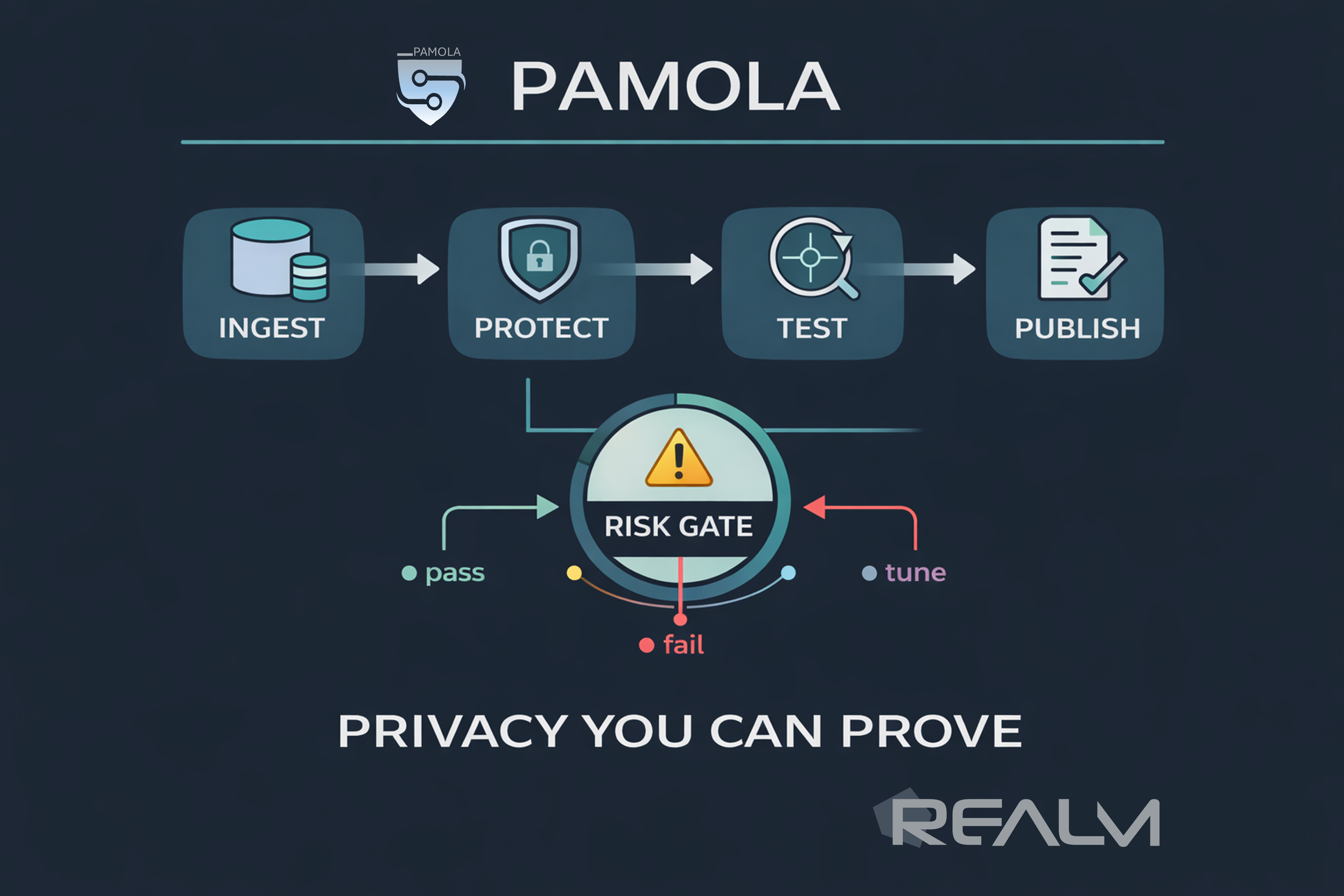
PAMOLA is deployed inside your environment and orchestrates governed data pipelines end-to-end - from privacy controls to approval-grade evidence.
- Deploy PAMOLA inside your VPC, sandbox, or sovereign cloud - no external data movement required.
- Connect to your existing data infrastructure and register datasets with explicit governance and usage constraints.
- Run AI and analytics pipelines with enforced privacy techniques, full traceability of transformations, and policy-bound execution.
- Automatically generate an Evidence Pack - including transformation logs, data-flow diagrams, applied controls, metrics, and approval artifacts.
Prove it works in 30–45 days
Don’t wait for perfect. Prove AI on sensitive data is possible - in your environment, with your governance team’s buy-in.
Sprint cadence
| Weeks | Focus |
|---|---|
| 1–2 | Environment setup & scope definition |
| 3–4 | PAMOLA deployment & workflow configuration |
| 5–6 | Evidence Pack assembly & governance readiness |
Designed to be a fast, evidence-driven path from “maybe” to an informed go / no-go decision.
What you get:
-
- Evidence Pack v0 - transformation logs, controls documentation, and data-flow diagram
- Privacy / utility metrics - quantified results your team can evaluate
- Deployment runbook - repeatable path from pilot to production
- Governance artifact - evidence package for internal review and sign-off
What we don’t do: we don’t take your raw data, we don’t require data egress, we don’t need production access, and we don’t promise instant results.
Who uses PAMOLA
Built for regulated environments where data governance is a prerequisite for using AI - not an afterthought.
Regulated enterprises
Payments, banks, insurers, and organizations with sensitive data that cannot leave the perimeter.
Outcome: unblock AI pilots stuck in governance review.
AI & data teams
Data science and ML teams working with sensitive data under strict privacy, risk, and compliance constraints.
Outcome: move from blocked experimentation to approved AI operations.
RegTech & compliance partners
Vendors and integrators embedding privacy, risk, and audit evidence into customer deployments.
Outcome: deliver artifacts customers can actually approve.
Engineered for scale
8 interconnected domains, 60+ entities, 400+ attributes — governed by 11 formal specifications. Explore the architecture that makes measurable privacy possible.
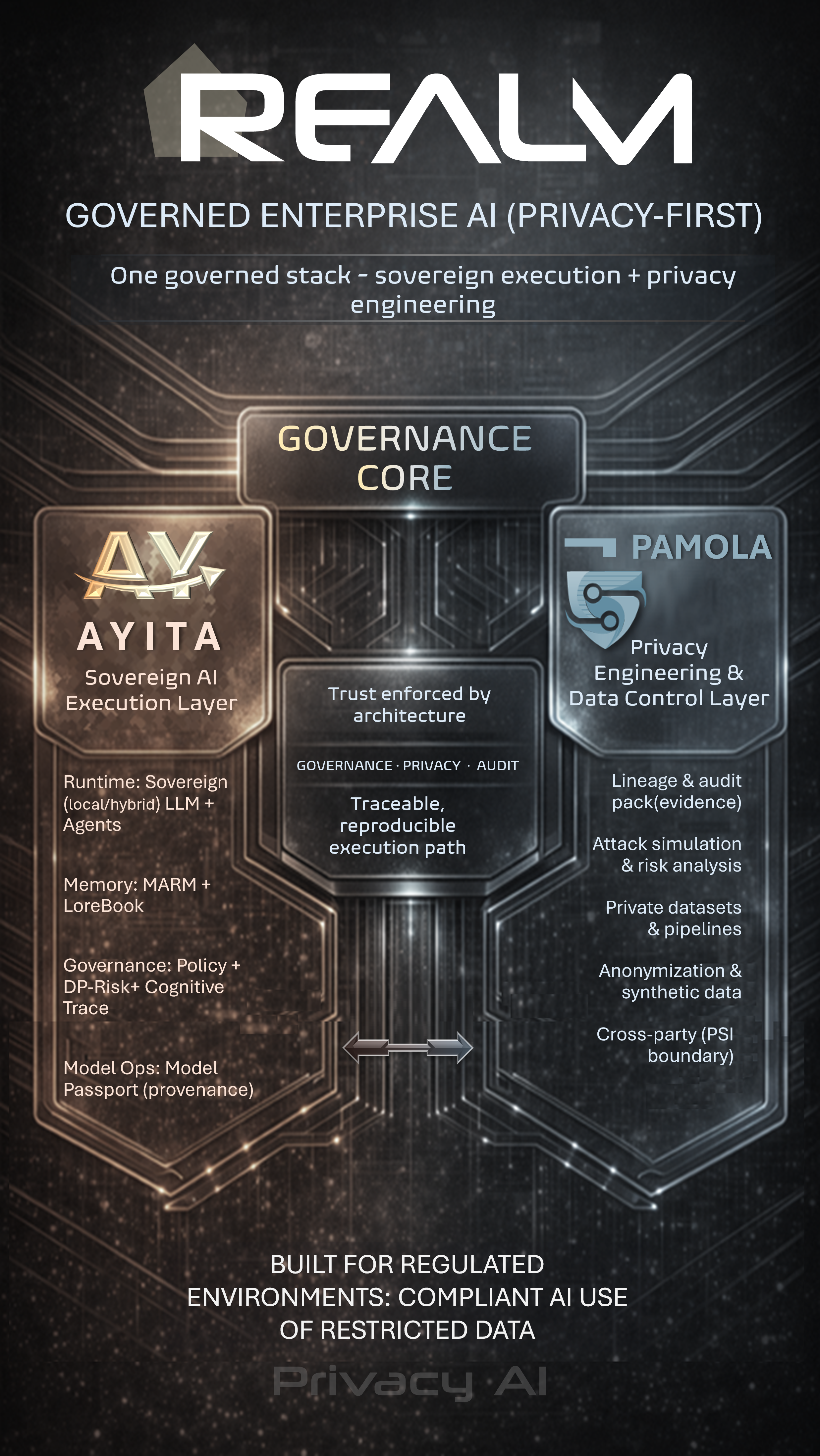
One Governed Stack
AYITA + PAMOLA = REALM - sovereign execution meets privacy engineering
AYITA
Governed Runtime: deterministic context assembly, organizational memory (MARM), policy-bound workflows, and traceable decision provenance.
PAMOLA
Trust and evidence layer for sensitive data: privacy orchestration, measured risk–utility tradeoffs, and audit-ready governance artifacts.
PAMOLA in action
A narrated walkthrough showing PAMOLA workflows - from privacy configuration and risk metrics to audit-ready governance artifacts.
Ready to see PAMOLA in your environment?
Contact us about the Evidence Sprint